Is a Master’s Degree Still Worth It In 2026?
By Alex Jue | Spring 2026 – Volume 16
For decades, college graduates have faced lower
unemployment rates, lower barriers to entry-level roles,
and more stability in employment than high school
graduates without college educations. Along with higher
wages, these advantages and benefits reinforced highereducation
since it became more accessible to the public
scholars as a way to achieve financial stability and
security. Recently, these advantages and benefits seem to
be going away as more and more young adults are
seeking undergraduate education. This erosion and
“oversaturation” of bachelor’s degrees has led some
students to wonder if holding off on entering the labor
market to get a Master’s degree is worth their time,
money, and young adult years for the candidacy
separation.
Oversaturation of Bachelor’s Degrees
The current job market no longer rewards bachelor’s
degree holding individuals as it once did. Vice
president of Think Tank at the Roosevelt institute
Suzanne Kahn says “Since 2023, 85% of the
unemployment rate is concentrated in new market
entrants, with unemployment for college graduates
being triple that of everyone else.” Employers are now
beginning to see a bachelor’s degree as a “minimum
ticket to ride” as president of the Burning Glass
Institute Matt Sigelman puts it. This in itself is
pushing more and more young adults to pursue a
degree in college, as it’s marketed as the only way for
one to obtain stable employment, higher-level
positions, and of course, a fat paycheck. However,
this marketing campaign for pursuit of higher
education has only led to an oversaturated pool of
qualified candidates competing for entry-level
opportunities that have not kept pace. These trends
reveal a present day workforce that is reluctant to
make room for new, adequately skilled, college
graduates. As a result of this, many young adults are
finding themselves stuck in a cycle of
underemployment or job searching that stretches
months after graduation, highlighting how the
oversaturation of bachelor’s degrees has weakened the
degree’s value as a reliable path to stable, happy
living.
This degree weakening can be seen in Figure 1 as the
unemployment gap between high school and college
graduates aged 22-27 has declined continually since the
2008 financial crisis. The gap has recently reached its
lowest level since 1970. The shrinking employment gap
has been accompanied by a secular decline in the jobfinding
rate. Figure 1a shows the unemployment rates for
both high school and college graduates, while figure 1b
illustrates the convergence of the two groups. The dashed
lines show raw data with seasonal noise whilst the solid
lines show the trends smoothed out.
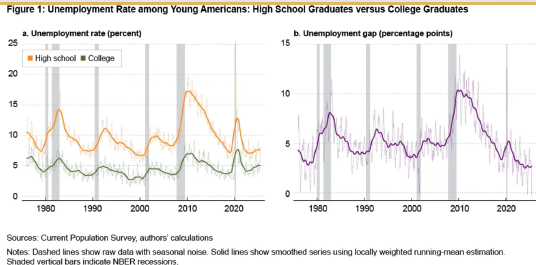
While college graduates still maintain their advantages
somewhat, the gap has been steadily narrowing since 2008. This conversion documented only concerns the initial step of securing employment rather than overall
labor market outcomes. There’s no denying the benefits
and advantages of going to college, but there’s also no
denying the fact that it’s difficult to land meaningful
positions in this market given the looming threat of hefty
student loans.
Hello AI, Goodbye Jobs?
With this in mind, it’s also important to consider what the
volatile economy is starting to demand of young workers.
With the increased technologization of the economy and
ever increased demand for skills with said new technology,
certain degrees (and skills) are preferred more than others.
Tools and technology such as AI have emerged as a
transformative force in the labor market. Reshaping the
nature of jobs and roles across various industries. As AI
continues to advance, the impact it has on the job market
is multifaceted.
On one hand, it raises concern over job
displacement and automation over administrative and
clerk roles, but it also has potential to create new job
opportunities in fields such as data analytics, machine
learning, and AI development. According to the
International Economic Development Council, AI is a
tool that can, and should be harnessed–this can be
achieved through “Proactive policy measures,
investment in education and training, and commitment
to ethical AI development and implementation.” More
than ever, employers are not only looking for a degree,
but they’re also looking at whether a candidate can use
the knowledge and experience they obtained while
getting their degree, to automate and accelerate the
tasks that their jobs demand.
The Real Cost
With the oversaturation of bachelor’s degrees and
increasing demand for certain skillsets to pay off large
sums of student-debt, young adults are exiting the labor
force and turning to higher education for potential
higher earnings, career advancement into higher roles,
and opportunities for career pivots. However, these
potential advantages come at a cost–typically ranging
from $44,640-$71,140 with the average cost of a
Master’s degree coming in around $62,820. Programs
generally take up to two years to complete and students
are as likely to receive financial aid as undergraduate
and doctoral students. Evidently, master’s programs
differ across institutions and areas of focus. The average
cost of a Master’s at a public school is $51k with private
schools charging more than a 20% increase to students
at $62k.
Cost also differs at public schools regarding in-state vs
out-of-state students with University of Michigan’s
school of Public Policy charging nearly a 100% markup
for out-of-state students. On top of the direct financial
costs, there are also indirect financial costs such as lost
income for the two years someone is studying and
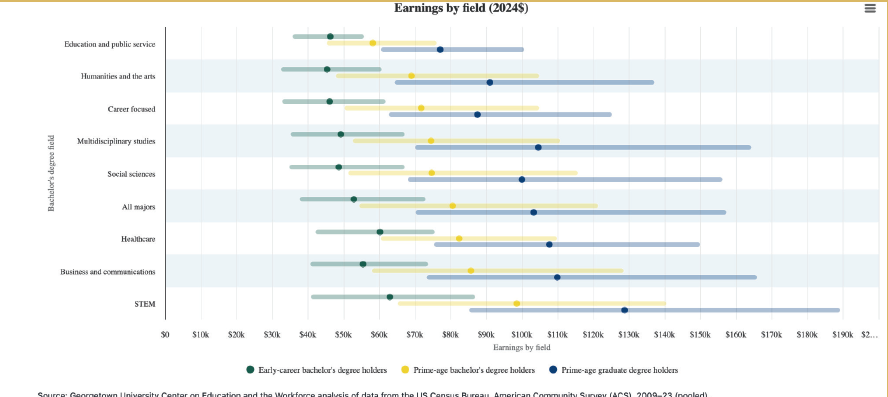
interest on student loans. Figure 2 exhibits the median
incomes from early-career bachelor’s degree holders
(aged 22-26), prime-age bachelor’s degree holders (aged
26-54), and prime-age graduate degree holders.
Across all majors, median income right out of college is
$53k, this means those who choose to pursue a master’s
degree after graduation are losing out on nearly $100k
of income on top of the tens of thousands of dollars
they’re spending to even attend graduate school. For
people who choose to attend graduate school later on,
they’re missing out on even more income. On top of the
lost income, there are also many opportunity costs to
higher education. Time spent being a full time student is
time that could’ve been spent doing anything else that
could have generated utility: this is including, but not
limited to spending time with family and friends,
learning a new hobby, going on a trip to a new country,
living in a new city etc… The costs of pursuing a
master’s is evident, but there are also major benefits that
make it a great return on investment.
The Benefits
Like earlier, graduate degrees offer higher wages,
according to the Bureau of Labor Statistics, in 2022, the
median amount that Master’s degree holders earned was
about 16% more weekly than their bachelor’s degree
counterparts. Along with the added skillsets and expertise
that open opportunities for more advanced, specialized
roles–which evidently offers better pay. Master’s programs
tend to offer hands-on research experience with real world
applications, which allows students to build confidence
and candidacy within the field they’re intending to work
in. Additionally, master’s programs offer students strong
professional networking opportunities. Alumni of
distinguished programs such as these are often wellversed,
experienced professionals in their respective fields,
and having individuals like these in one’s network can help
immensely in the job search later down the line.
Unemployment rate for master’s holders are also lower
than bachelor’s holders. According to the U.S. Bureau of
Labor Statistics, the unemployment rate for master’s
degree holders is 0.3% lower. These benefits are quantified
when discussing lifetime earnings between bachelor’s and
master’s holders. The lifetime earnings value of a master’s
degree is approximately $400,000 more than that of a
bachelor’s degree alone as seen in the figure below.
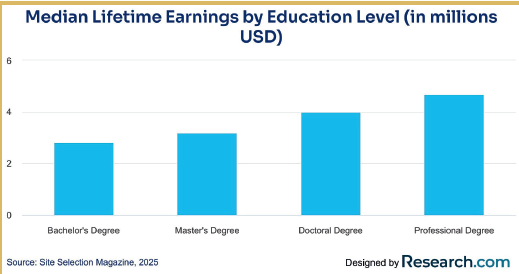
This significant gap highlights the degree’s true financial
worth isn’t just initial salary bump, but in its long-term
value on one’s entire career trajectory. This long term value
is created by all the benefits discussed earlier. A master’s
degree is an investment in peak earning years (middle life),
not just the next job. The average cost of a graduate degree
across all types of schools is about $73,520, along with the
hidden opportunity costs of about $100,000, that makes
the average total costs of attending graduate school just
south of $200,000. However, the purpose of master’s
degrees isn’t just to start earning significantly more right
away, it’s an investment on one’s entire career.
As seen above, the average monetary benefits of
pursuing a master’s degree is about $400,000–making
graduate programs enticing for someone looking to earn
more, change their career path, or stand out.
Are All Master’s Degrees Created Equal?
No. Not all graduate programs are made the same.
According to a report from The Foundation for
Research on Equal Opportunity, the median master’s
degree has a net ROI (increase in lifetime earnings minus
the cost of attending school) of about $83,000. Some
master’s degrees are worth over $1 million, while nearly
40% have no net financial value at all. To start, let’s
analyze fields of study and how they differ based on ROI
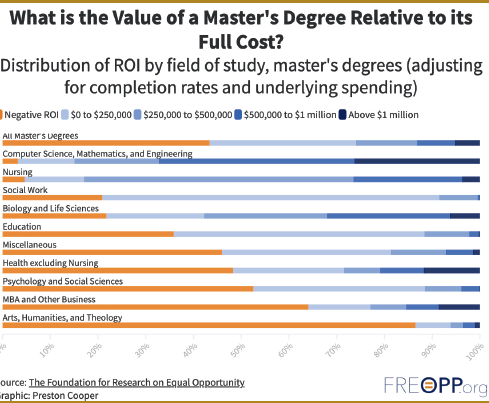
as the median ROI of $83,000 is misleading. In the
figure below, 40% of master’s degrees offer a negative
ROI, but this is less for some degrees, and substantially
more for others.
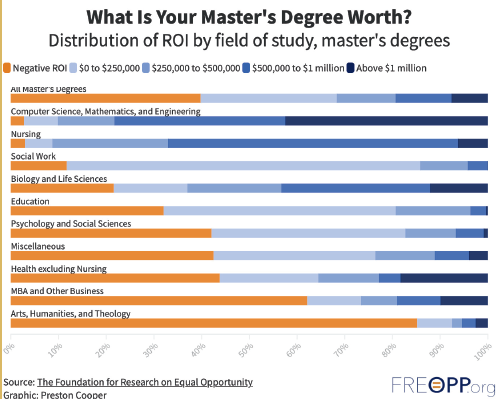
As you can see, the master’s degrees with the most
consistently positive ROI are in the STEM field such as
computer science, mathematics, engineering, nursing, and
biology. One degree that surprisingly fails to pay off
students is the MBA. More than 60% of MBA holders do
not show a positive return, even though MBAs are
significantly popular today. What’s interesting about the
MBA though, is that it has a long upper percentile of elite
programs with great ROI (north of $1 million). Why is
this? It mostly has to do with the prestige of some of these
MBA programs (as well as the networking opportunities
and lucrative alumni network). There is a significant
benefit from attending elite institutions and ROI.
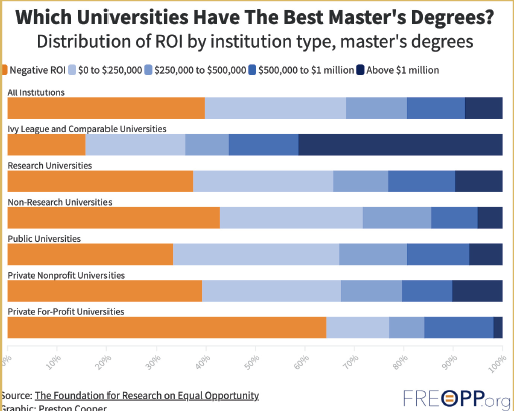
It’s evident that known programs with Ivy league status
offer better programs with higher ROI’s. So when
considering a master’s program, it’s also important to
consider what the institution you’re attending offers
beyond what it will teach you. For this metric, cost of
attendance at each type of institution plays a significant
role in calculating ROI. Public universities tend to offer
lower tuition costs than private universities, and this
shows with public universities having 6% less negative
ROI programs than private nonprofit universities, and an
even larger gap for private for-profit universities.
The Major Differences
So, you’re about to graduate from university with your
bachelor’s degree. Do you go straight to the labor
market (hopefully you have a job lined up) to work and
build your professional experience? Or are you going to
delay your entry into the labor market and pursue
higher education in hopes to boost your candidacy to
potentially further your career? Values and benefits for
master’s degree programs vary immensely, it’s
impossible to answer the question with a definitive yes
or no. As seen in the figure to the right, the value of
master’s degrees relative to full cost varies by field of
study, institutions, and timing of education as well.
In this graphic, it’s evident that most STEM programs
pay off, but as we take a look at more humanities and
business-related programs, positive ROI is far from
universal.
For many career fields, a master’s degree can be helpful in
distinguishing yourself, protecting yourself from cyclical
economic issues, and connecting yourself to
professionals. But for others, it is a costly distraction at
best and “a career impediment at worst.” While higher
education-especially at the undergraduate level–leads to
important skills and higher earnings, this positive
relationship fades at the graduate level. It’s safe to say, the
value of master’s degrees depends on the field of study
and the institution–especially when taking explicit costs
into account. When taking these costs into account, a
sizable amount of master’s programs simply aren’t good
investments. 40% of programs do not show positive
return, and this proportion only rises by 3% when taking
into account underlying costs and non-completion. Not
all master’s degree programs are created equal, some are
even counterproductive. The final ROI of the degree is
also not determined by the diploma itself, but by the
intentionality of the person who earns it. Will they use it
to leverage their candidacy for future job opportunities?
Maybe. Will they use it to pivot in their career for better
pay? That’s on them to decide. There are a lot of factors
that go into the ROI and worth of a master’s degree, but
ultimately, it falls on the owner to exhaust all of the
resources and opportunities it provides. So, is a master’s
degree worth it? The answer is a resounding “it depends.”
BLS, U.S. (2025) Education pays, U.S. Bureau of Labor Statistics.
Available at: https://www.bls.gov/emp/tables/unemploymentearnings-
education.htm
(Accessed: 17 March 2026).
Cline, Alexander, and Barış Kaymak. 2025. “Are Young College
Graduates Losing Their Edge in the Job Market?” Federal Reserve
Bank of Cleveland, Economic
Commentary 2025-14. https://doi.org/10.26509/frbc-ec-202514
Cooper, P. (2026a) Does college pay off? A comprehensive return
on investment analysis – FREOPP, The Foundation for Research on
Equal Opportunity. Available at:
https://freopp.org/whitepapers/does-college-pay-off-acomprehensive-
return-on-investmentanalysis/#:~:
text=The%20median%20master’s%20degree%20deliver
s,leave%20students%20much%20worse%20off. (Accessed: 17 March
2026).
Cooper, P. (2026b) Is grad school worth it? A comprehensive return
on investment analysis – FREOPP, The Foundation for Research on
Equal Opportunity. Available at: https://freopp.org/whitepapers/isgrad-
school-worth-it-a-comprehensive-return-on-investmentanalysis/#:~:
text=This%20report%20estimates%20return%20on,ha
ve%20ROI%20above%20$1%20million. (Accessed: 17 March 2026).
Gray, K. (2025) Differential in starting salaries between bachelor’s
and master’s grads is diminishing, national association of
college+employers. https://www.naceweb.org/job-market/trendsand-
predictions/differential-in-starting-salaries-between-bachelorsand-
masters-grads-is-diminishing (Accessed: 17 March 2026).
Gulish, A. et al. (2024) Graduate Degrees Offer High Rewards and
Rising Risks, Higher Education Today. Available at:
https://www.higheredtoday.org/2024/10/10/graduate-degrees-offerhigh-
rewards-and-rising-risks/ (Accessed: 17 March 2026).
Hanson, Melanie. “Average Cost of a Master’s Degree”
EducationData.org, 2024-11-23, https://educationdata.org/averagecost-
of-a-masters-degree
Imed, B. (2026) 2026 is a master’s degree worth it? benefits, costs &
salary | research.com, Reasearch.com. Available at:
https://research.com/degrees/is-a-masters-degree-worth-it-benefitsof-
a-masters-degree (Accessed: 17 March 2026).
Outlook, C. (2023) Education pays, 2022, U.S. Bureau of Labor
Statistics. Available at:
https://www.bls.gov/careeroutlook/2023/data-on-display/educationpays.
htm (Accessed: 17 March 2026).
Revier, B. (2025) Why a college diploma no longer guarantees
success, MarketPlace.org. Available at:
https://www.marketplace.org/story/2025/07/29/why-a-collegediploma-
no-longer-guarantees-success (Accessed: 17 March 2026).
Torpey, E. and Terrel, D. (2015) Should I get a aster’s Degree?,
U.S. Bureau of Labor Statistics. Available at:
https://www.bls.gov/careeroutlook/2015/article/should-i-get-amasters-
degree.htm (Accessed: 17 March 2026).
University, G. (2025) The major payoff: Evaluating earnings and
employment outcomes across bachelor’s degrees, CEW
Georgetown. Available at: https://cew.georgetown.edu/cewreports/
major-payoff/ (Accessed: 17 March 2026).
Welding, L. (2024) How much does a master’s degree cost? tuition
and fees, Bestcolleges.com. Available at:
https://www.bestcolleges.com/research/masters-degree-cost/
(Accessed: 17 March 2026).