Acquisition or Organic Growth? A DoubleEvent Study of Netflix’s Attempted Mergerwith Warner Bros. Discovery
By Kayvan Sinha | Spring 2026 – Volume 16
Introduction
Netflix transformed the entertainment
industry in 2007 when it pivoted from a
mail-in DVD service to an online streaming platform, giving viewers immediate, ondemand
access to its movie collection. As audiences
discovered they could watch entire seasons and movies
at any time, the ‘binge-watching’ phenomenon took
hold, and the era of the streaming wars began. Today,
competition extends beyond traditional media
companies to big tech too. As of 2025, Netflix leads the
industry with over 300 million subscribers, followed by
Amazon Prime Video at approximately 200 million and
Disney+ at around 125 million (Corpolongo, 2025).
The battle for market share has driven platforms to
aggressively pursue premium content: original
productions, licensed fan favorites and increasingly, live
sporting events. Yet, growth has come at a cost. As
expenditures rise, so do subscription prices. Consumers
find themselves paying for several subscriptions
simultaneously just to access the content they want,
giving rise to what the industry calls “subscription
fatigue”. Platforms have responded with ad-supported
subscriptions offering lower-cost access in exchange for
advertisements, a model that industry analysts project
will become the dominant growth engine for the sector.
However, sustaining that growth requires scale which,
in this industry, means consolidation. As streaming
platforms face mounting pressure to grow in an
increasingly saturated market, the strategic choice
between organic growth and large-scale acquisition has
become a defining tension of the streaming wars.
It is on this basis that Netflix announced t
heir acquisition of Warner Bros. Discovery on
December 5th, 2025, for a total enterprise value of
$82.7 Billion (Netflix, Inc., 2025).
It was a deal that, if completed, would
have reshaped the streaming industry entirely,
combining Warner Bros.’ world class studios with Netflix’s
global reach. Less than three months later, on February 26,
2026, Paramount Skydance came out on top of the bidding
with a with a huge bid of $31 a share in cash, beating
Netflix’s proposed $27.75 (Rizzo and Sherman).
This paper explores the growth imperative driving the
modern streaming industry through the case of Netflix’s
attempted acquisition of Warner Bros. Discovery,
examining how equity markets responded to both events
using a double event study methodology following
MacKinlay (1997). Our findings reveal a striking reversal:
markets penalized Netflix upon announcement while
rewarding it sharply upon exit. This is broadly consistent
with Jensen & Ruback (1983), who present evidence across
numerous studies that target firms capture significant
acquisition premiums averaging 20% abnormal returns,
while bidding firms earn close to zero. Netflix’s negative
announcement returns likely reflect the uncertainty
inherent in a deal of this scale: regulatory scrutiny from the
DOJ, financing concerns, and Warner Bros. Discovery’s
existing debt burden. The sharp reversal upon collapse
suggests markets welcomed the resolution of that
uncertainty, interpreting Netflix’s withdrawal not as a
defeat, but as the more disciplined outcome for
shareholders.
Methodology
Daily closing price data for Netflix Inc. (NFLX), Warner
Bros. Discovery (WBD) and the SPDR S&P 500 ETF
(SPY) were collected using the yfinance Python library,
pulling five years of trading history for each ticker. Two
corporate events are studied. Event 1 is the Netflix
acquisition announcement on December 5, 2025. Event 2 is
the deal collapse on February 26, 2026, when Netflix
withdrew and Paramount won the bidding war for Warner
Bros. Discovery.
Normal performance is calculated using a standard market
model which relates the return of any stock price to the
return of the market portfolio, following from the assumed
joint normality of asset returns:

A single estimation window [-120, -30] before event 1 is
applied uniformly to both events to prevent parameters
from being contaminated by either the acquisition
announcement or the deal collapse. Event window of ±15
calendar days and ±5 calendar days for events 1 and 2
respectively are extracted around the event date to support
graphical analysis of cumulative abnormal returns
(CARs). Daily abnormal returns are computed as the
difference between realized returns and expected returns
from the market model. CARs are then constructed by
cumulative summation of daily abnormal returns within
each window. Statistical inference is conducted across five
event windows: [-1, +1], [-3, +3], [-5, +5], [-10, +10] and
[-15, +15]. For each window of half-length w, the CAR
test statistic is:

where is the residual standard deviation from the
estimation window regression and n=2w+1 is the total
number of trading days in the event window of halflength
w.
Results
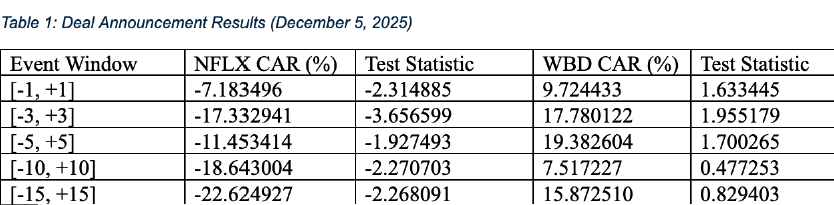

Table 1 presents cumulative abnormal returns and
associated test statistics for both NFLX and WBD across
five event windows surrounding the deal announcement
on December 5, 2025. NFLX exhibits statistically
significant negative CARs across all event windows,
ranging from -7.18% at [-1, +1] to -22.62% at [-15, +15].
In contrast, WBD recorded positive CARs across all
windows, reaching 9.72% at [-1, +1] and 15.87% at [-15,
+15], though none reach conventional levels of statistical
significance. These findings are illustrated in Figure 1.
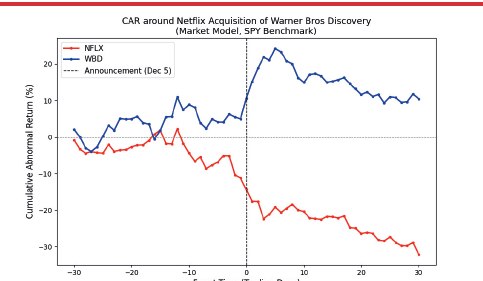
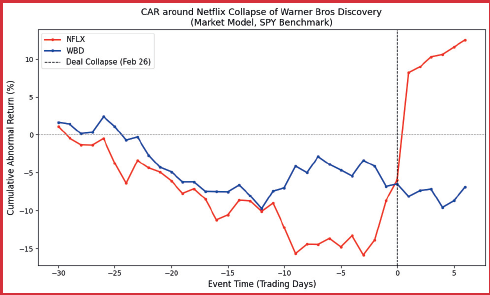
Table 2 presents cumulative abnormal returns and
associated test statistics for both NFLX and WBD
across three event windows surrounding the deal collapse
on February 26, 2026. NFLX exhibits highly significant
positive CARs across all windows, ranging from 22.02%
at [-1, +1] to 25.20% at [-5, +5]. WBD recorded negative
CARs across all windows, reaching -4.81% at [-5, +5],
though none reach conventional levels of statistical
significance. Results for the [-10, +10] and [-15, +15]
windows are omitted as the post-event observation
period remains incomplete at the time of writing. These
findings are illustrated in Figure 2.
Discussion
Notably, Figure 1 reveals a pattern of negative abnormal
returns beginning to accumulate in the days prior to the
announcement, while Figure 2 shows NFLX CARs
beginning to recover approximately three days before the
official collapse date. Both are consistent with
information leakage ahead of their respective public
announcements.
The Acquirer’s Penalty
A successful acquisition would’ve meant $70 billion new
debt for Netflix to finance the all-cash offer, multiplying
their existing $13.5 billion existing debt by 5 times
(Bylund). With only $9 billion cash reserves, the market
understandably didn’t trust in the altered balance sheet
with integration risk adding to the uncertainty of the deal.
According to the market, that risk outweighed even the
reward of acquiring such a well renowned movie studio. In
addition to the debt burden, market saturation has been a
growing concern for all streaming platforms. Netflix
specifically had 23 million subscriber additions in 2025
compared to 41 million additions in 2024, a decline of
nearly 44% in annual subscriber additions (Trefis Team,
2026). Maturing user acquisition led the market to
question whether an acquisition like this could generate
sufficient returns to justify the fivefold increase in debt.
Any consolidation of this size requires regulatory approval
from the DOJ antitrust
division.
While this may not directly drive the negative abnormal
returns, uncertainty likely led to a “wait-and-see” behavior
creating regulatory overhang that weighed on the NFLX
share price throughout the announcement window.
Additionally, the rival bidders, Paramount CEO David
Ellison and his father Larry Ellsion, have close ties with the
Trump administration hinting that a Paramount deal may
always face a more favorable regulatory path, adding to the
undermining confidence in Netflix’s bid. Finally, analysts
projected a 10% increase in content investment, adding
further pressure to the already strained balance sheet.
Netflix’s Plan B
“We’ve always been disciplined, and at the price required to
match Paramount Skydance’s latest offer, the deal is no
longer financially attractive” (Netflix, Inc., 2026). With the
deal overhang lifted, Netflix’s ambitious 2026 content
roadmap, committing to a staggering $20 billion
investment, suddenly became the story, driving the 22%
CAR in the [-1, +1] window. Central to this roadmap is
Netflix’s expansion into the ad-supported tier. Ad revenue
grew 2.5x in 2025, surpassing $1.5 billion, with
management targeting $3 billion in 2026 (Trefis Team
2026). The ad-supported tier now accounts for 55% of all
new sign-ups in available markets, reaching 190 million
monthly active viewers, a scale that makes Netflix an
increasingly compelling proposition for advertisers in a
U.S. digital ad market projected to exceed $422 billion.
Netflix plans to deploy that $20 billion not only in
premium films and series, but in live events like NFL
games, WWE Raw, and award shows, which command
significantly higher ad rates due to real-time simultaneous
viewership. Owning its in-house ad technology stack
further strengthens this position, enabling precise first
party targeting without reliance on third-party data. At the
end of the day, Netflix didn’t just avoid bad debt. Instead,
they got paid $2.8 billion to walk away and focus on
strategic investments rather than regulatory preparations
(Rizzo and Sherman).
The AOL-Time Warner merger of 2000, widely regarded as
one of the most catastrophic in corporate history, resulted
in a $98.7 billion loss in a single year, a cautionary
reminder that was not lost on Netflix’s board or its
investors (Higgins).
The market’s response to the deal collapse suggests that
calculated organic growth and shareholder-friendly capital
allocation are more attractive than the kind of megamerger
that defines the reckless era of the streaming
wars. While WBD’s market reaction reinforces the broader
narrative, it warrants brief discussion. Upon the
acquisition announcement, WBD recorded positive CARs
across all event windows, reaching 19.38% at [-5,+5],
consistent with the target premium documented by Jensen
& Ruback (1983), though falling short of conventional
significance thresholds. Following the deal collapse, WBD’s
CARs were negative but again insignificant, suggesting
that markets quickly redirected expectations toward
Paramount’s competing bid at $31 per share, a higher
valuation than Netflix’s proposed $27.75. The proposed
Paramount-WBD merger, however, raises its own set of
concerns. With two legacy studios merging their content
libraries, the consolidation of intellectual property under a
single platform risk reducing the diversity of films and
series available to consumers, a tension between market
efficiency and cultural output that extends well beyond the
scope of this paper.
Limitations
This methodology does not come without its limitations.
Most notably, the findings are based on a single deal
between two firms, limiting the generalizability of the
results. The market reactions observed here may reflect
circumstances unique to Netflix and Warner Bros.
Discovery rather than a broader pattern in M&A. The
shared estimation window, while necessary to prevent
parameter contamination across events, assumes stable
market relationships throughout the study period, and the
wider event windows for Event 2 remain preliminary
pending a full post-event observation period. Finally, the
market model itself may not fully isolate abnormal returns
attributable to the deal since confounding events such as
earnings releases or broader sector movements during the
event windows cannot be entirely ruled out, and the
assumption of a constant beta may not hold in a sector as
volatile as streaming.
Conclusion
The implications of the proposed merger of Paramount
and Warner Bros. Discovery, uniting Paramount + and
Max into a single platform, for the broader streaming
landscape remain uncertain, but this paper’s findings
suggest that equity markets strongly endorsed Netflix’s
decision to withdraw.
With a CAR of 25.20% across the [-5, +5] window
surrounding the deal collapse, significant at the 1%
level, the market’s verdict was clear: the risk of
absorbing Warner Bros. Discovery’s debt outweighed
the strategic reward. As Netflix pivots toward adsupported
growth and increasing monetization rather
than subscriber volume, its path to competing in a
consolidated industry may lie not in matching its rivals’
scale, but through organic growth focused on
maintaining value and choice for the consumers.
MacKinlay, A. Craig. “Event Studies in Economics and Finance.”
Journal of Economic Literature, vol. 35, no. 1, 1997, pp. 13–39,
www.jstor.org/stable/2729691?seq=2.
Netflix, Inc. Netflix to Acquire Warner Bros. Following the
Separation of Discovery Global for a Total Enterprise Value of
$82.7 Billion (Equity Value of $72.0 Billion) . 5 Dec. 2025,
about.netflix.com/en/news/netflix-to-acquire-warner-bros.
Netflix, Inc. Netflix Declines to Raise Offer for Warner Bros. 26
Feb. 2026, about.netflix.com/en/news/netflix-declines-to-raiseoffer-
for-warner-bros.
Jensen, Michael C., and Richard S. Ruback. “The Market for
Corporate Control: The Scientific Evidence.” Journal of Financial
Economics, vol. 11, no. 1-4, Apr. 1983, pp. 5–50,
https://doi.org/10.1016/0304-405X(83)90004-1.
Team, Trefis. Netflix Is Betting Big on This $400 Billion Market.
22 Jan. 2026, www.trefis.com/stock/nflx/articles/588244/netflix-isbetting-
big-on-this-400-billion-market/2026-01-22.
Corpolongo, Dominic. Video Streaming Services Industry Report.
12 Feb. 2025.
Billy Thompson. “The Rise and Fall of Streaming TV? – Michigan
Journal of Economics.” Michigan Journal of Economics, 25 May
2024, sites.lsa.umich.edu/mje/2024/05/25/the-rise-and-fall-ofstreaming-
tv/.
Bylund, Anders. “How Netflix Stock Gained 15.3% Last Month.”
The Motley Fool, 6 Mar. 2026,
www.fool.com/investing/2026/03/05/how-netflix-stock-gained-153-
last-month/.
Rizzo, Lillian, and Alex Sherman. “Netflix Ditches Deal for
Warner Bros. Discovery after Paramount’s Offer Is Deemed
Superior.” CNBC, 26 Feb. 2026,
www.cnbc.com/2026/02/26/warner-bros-discovery-paramountskydance-
deal-superior-netflix.html.
Higgins, Bill. “Hollywood Flashback: Time Warner, AOL Entered
a Doomed $182 Billion Alliance 20 Years Ago.” The Hollywood
Reporter, 11 Jan. 2020,
www.hollywoodreporter.com/business/business-news/hollywoodflashback-
time-warner-aol-entered-a-doomed-182-billion-alliance-
20-years-1267322/#:~. Accessed 26 Mar. 2026.
Team, Trefis. Netflix Stock Dropped -30%, Here’s Why. 12 Feb.
2026, www.trefis.com/stock/nflx/articles2/590568/netflix-stockdropped-
30-heres-why/2026-02-12.