The Economics of Wisconsin Dairy
By Justin Dickman and Declan Rafter | Spring 2026 – Volume 16
On a dewy morning in Greenleaf WI, Jim Leick rolls
out of bed at 4:30 AM and throws on a pair of jeans
before greeting the gray gravel paths and navy blue feed
silos at Greenleaf Ledge Dairy family farm (GLD).
Approximately 700 cows rely on the Leick Family and
approximately 10-15 employees. If these cows have been
lucky enough to get pregnant and bring a calf to term
in the last 10 months, their udders will be swollen with
priceless American milk. Jim is the fourth generation of
GLD family owners, and now more than ever his
resolve to keep the farm in the family is a necessary
virtue. Life on the farm is idyllic, but sometimes
frighteningly unpredictable. “Every day is a new
adventure” Jim says in a slightly sardonic tone at his
interview in February.
On September 15th of 2022, the floor leading from the
cattle holding pen to the milking parlor collapsed as
cows passed over it; the collapse created a situation that
forced Jim to work through the night with an
emergency crew of assembled family and friends. The
new floor was constructed overnight. Many cows were
saved via an emergency system of chain pulleys and
uncomplaining stoicism. Operations continued the next
day, and so did Jim, wearing the exact same jeans. Even
on a day without calamity, Jim’s hands are full. Milkers,
herdspeople, equipment technicians, nutritionists,
veterinarians, bankers, and tax accountants all vie for
his time. To be a farmer in today’s world is a
multidisciplinary profession. Tina Leick, who is a
mother of three, middle school teacher, and the farm’s
primary financial clerk, had this to say about her
husband of over 25 years: “He likes being his own boss.” To Jim, life on the farm
is everything; from early morning to late at night, he
takes it all in. When asked about why he enjoyed this
line of work he stated, “The advantages of working
outdoors. You see the sunrise and the sunset, I wouldn’t
give it up for [anything].”
Input & Output Consolidation
Jim has remained resolute against a quickly changing
world that squeezes farmers between equipment
manufacturers, milk plants, and fluctuating prices. On
the equipment manufacturing side, Deere & Co.
accounts for 37% of the national market share,
meaning they can easily dictate input prices to farmers
attempting to make capital investments. The situation
does not fair better on the output side. Three
companies account for 83% of national milk sales. The
consolidation of these industries—an oligopoly—has
not escaped the recognition of eagle-eyed Jim Leick.
“It’s become limited now. 15 years or 20 years ago, we
had milk factories and milk plants knocking on your
door all the time…now you’re just happy you have
somewhere to go with it.”
The Historical Context of Agricultural Consolidation
Basel Musharbash, principal attorney at Antimonopoly Counsel, an antitrust
law and policy firm, has studied the political history that led to the current lax
application of anti-trust laws in the US agriculture industry. “These corporate
oligarchs…regularly abuse their power…to block innovation and honest rivalry
that threaten their interests, and to extract wealth from farmers, workers, and
consumers alike.” The root cause of increased extraction from farmers relative
to prices received is the corporate oligarchy that Musharbash describes.
America has seen this level of concentration before, and it was in large part
ameliorated by 1930s New Deal trust-busting policies that helped antebellum
America achieve “a burgeoning yeomanry of local grocers and pharmacists,
small manufacturers and entrepreneurs, industrial workers and independent
professionals.” Through the 1960s competition for dairy farmers’ milk grew.
Anti-merger and anti-discrimination enforcement by the Federal Trade
Commission (FTC) facilitated the rise of dozens of middle-tier milk processors
around the US and diminished the power of the industry’s national leaders. By
the 1970s, this climate had taken a dramatic turn.
“The Nixon, Ford, and Carter administrations
progressively pursued deregulatory policies that attacked
the safeguards for fairness and competition in agriculture,
gradually breaking down the competitive economic order
inherited from the New Deal, and putting the country on a
path back to the pro-monopoly farm and antitrust policies
of the 1920s…the Reagan and Clinton
administrations gave the green light to rapid consolidation
across the country’s food system, and
ultimately abandoned the supply management programs
that had been critical to maintaining the
independence of family farmers and the decentralization
of power in agricultural production (p.29)”
A Useful Measure of Consolidation
The newest trend of consolidation was not curbed by a
second New Deal. Instead, it was allowed to grow. The
Herfindahl-Hirschman Index (HHI) is a useful measure
of concentration within a market that creates a
standardized scale for means testing. The HHI measures
market concentration by squaring the market share
percentage of each firm in an industry and summing
them, resulting in a range from near 0 to 10,000. An HHI
below 1,500 indicates a competitive market, 1,500–2,500
is moderate concentration, and above 2,500 is highly
concentrated. In 2024, The HHI value exceeded 4,100 for
the North American large-tractor market, and 4,600 for
the combine market.
Why Helping Small Farmers with Preferential Loans Isn’t Enough
The consolidation and coercion of the agricultural input
markets mean smaller farmers’ ability to scale up is
limited without outside help. State legislators are
interested in providing that help, but legislators are not
operating in isolation. They must take into account the
preferences of corporate interests, such as the
Association of Equipment Manufacturers. Instead of
solving the root cause of increased input prices, the
Association of Equipment Manufacturers are lobbying
State Representative Clint Moses (R-Menomonie) and
State Senator Rob Stafsholt (R-New Richmond) to
introduce legislation that would “establish a Dairy
Innovation Fund in Wisconsin to help small and
medium-sized farms invest in next-generation agricultural
technology.”
Stafsholt argues a popular belief: “some of the
technology that can make farmers as efficient as possible
and would help the smaller guys to compete with the
bigger guys is often financially out of reach for our small
and medium farms.” Despite the well-intentioned
rhetoric, there is a fear that corporate interest groups will
dominate the narrative, and that the underlying issue of
industry consolidation will go unaddressed. Since the bill
is being supported by the Association of Equipment
Manufacturers who represent a consolidated industry, it
would likely entail large no-interest loans paid from
taxpayer revenue – a tax and spend plan –that would pass
through the bank accounts of farmers.
Ultimately, this would line the pockets of equipment
manufacturers within the association. Beyond the
structural fear that the Dairy Innovation Fund will serve
as a short term band-aid and not fix the underlying issue
of input consolidation, the original eligibility limits of this
progressive bill are being challenged. The original intent is
to limit access to these low/no interest loans to smaller
and mid size farms. In early January 2026, “major farm
and dairy industry representatives pushed for changes that
would allow large industrial farms to access the loans”.
The Effect of Consolidation on Wisconsin Dairy Farmers
When dairy farmers are facing price squeezes from both
sides, the unfortunate truth is that many choose to sell
their herds to larger dairy farms and exit the field. While
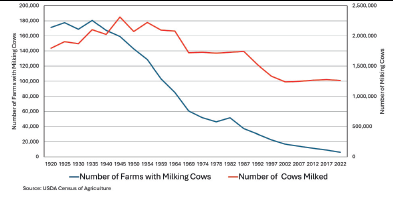
the number of cows milked in WI has seen a 44% decrease
since its all time high of 2.25 million in 1945, the number
of farms with milking cows has seen a 97% decrease. Less
farms are in the business of milk production, and the ones
that remain are much larger than their predecessors.
Facing consolidation from all sides, Jim has no choice but
to rely on frugality and pragmatic risk management to
stay above water during bad years. “Instead of investing in
a rotary parlor for the last 10 years…we’ve been custom
hauling manure and harvesting forage for other farms.”
GLD, Wiese, and Country Aire Farms all inhabit a span
of less than 10 miles in any direction. The land around
them is ripe for expansion. Country Aire farms recently
made a large capital investment announced by Dairy Star
Magazine in May of 2025. “The expansion included a new
80-stall rotary milking parlor and two new freestall barns
to house nearly 3,000 cows. This was accompanied by a
large-scale remodeling project of the farm’s four existing
freestall barns, holding area, and rotary parlor. Both
projects incorporated the latest technology. “Our old
parlor was limping along, and we didn’t know where we
were going to milk more cows,” Mike Gerrits said.
Wiese Farms is also making large steps towards
modernizing their farm. Dan Weise is excited about the
future of farming technology “I can’t even think beyond
ten years as to the things we’ll be able to do, drones are
flying around doing our spraying right now.” The Wiese
family had 14 children, and in 1982 divided the property
among six Wiese sons. In 1994, they reconsolidated and
built a dairy barn with a herd of 600. By 2025, they grew
from there to a herd of 6,000. The climate for growth was
more advantageous when the Wiese family expanded than
when the Leick family expanded. In 1994, Deere & Co.
accounted for 28% of the national equipment
manufacturing market as opposed to 37% in 2024. Deere
& Co. held a somewhat equal balance of power with Case
IH and New Holland. This healthy competition somewhat
controlled input prices for farmers attempting to expand
in the early 90s. Later recessions triggered consolidation
of firms that then led to equipment price increases. By
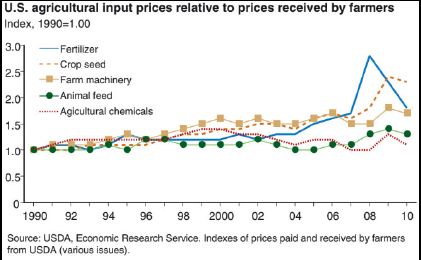
2010, farm machinery was almost twice as expensive
relative to prices farmers received for their products. The
USDA primarily attributes the beginnings of this recent
change to draconian advancements in environmental
regulation for diesel equipment. This, paired with periods
of recession darwinistically reduced market competition.
Environmental reform meant research and development to
reduce emissions, which led to more expensive equipment.
The equipment firms that survived the stringency of these
regulations emerged to a world where they held greater
market control. Earlier consolidation was catalyzed by
recessions.
“In the [US] farm machinery industry, many of the major
mergers and acquisitions can be traced to large financial
losses sustained by some leading firms during periods in
which the farm sector was in prolonged recession, which
substantially reduced demand for farm machinery as
farmers delayed major capital purchase.(Fuglie, p.25)”
In theory, the benefit of a consolidated market is that
knowledge is consolidated as well, which leads to
improved labor-efficient technology. While technological
progress may occur under government mandates as with
the environmental regulations, the long run suggests the
resulting market could suffer high firm consolidation.
Musharbash’s “corporate oligarchy” easily stifles new
competition and the innovations inherent in new growth.
Arthur Lewis’ modernized economy has arrived for
agriculture, at the cost of relinquishing price control to a
few companies. The Leicks officially bought the farm in
2000, and made large capital investments in 2009, when
farm machinery and other inputs began to cost
significantly more. Jim Leick recognizes the importance
of modernizing equipment both for efficiency and for
employee retention, but is hesitant to replace their older
herringbone parlor with a new rotary parlor due to the
size of the investment. “The rotary parlors are definitely
the answer, you just stand in one spot while they rotate
around..employees want to work at the farm with the
newest parlor because it’s easier on their body.” The issue
is the money: “Your parlor is the most expensive point.
We’re talking a $2 million investment.”
The Mental Impact of The Modern Farming Economy
Even with advanced machinery, life on the farm takes a
vigorous toll on its workers. Working with livestock
requires the capacity to remain calm as situations can
rapidly escalate and become dangerous, as was the case
when the floor caved in. Famer’s physical and mental
acuity must be sharp, otherwise operations will cease to
run efficiently. From fixing broken-down equipment in
the sweltering heat to rescuing calves stuck in their huts
due to snow drifts closing the openings, farm life
demands physical capability. There is simply no
allowance for corner cutting. “Farming can be
sustainable if you’re willing to put in the long hours [it’s
important to remember that] the next rainstorm is
always around the corner”. This attitude is one which
Jim Leick brings to work daily, even when life proves to
be difficult. When asked about the stress farm work
induces, Jim shrugged off its effects. “The stress
definitely gets to you when things ain’t going right. I’ve
been doing it for so long… it’s just another day.”
Elizabeth Leick, a psychology major at the University
of Wisconsin-Madison, and the eldest daughter of the
Leick family, sees this in a different perspective. “My
dad looks way older than any other 50 year old his age.
People mistake him for my grandpa all the time, just
cause he’s been outside working at least 12 hours a day,
like my whole life.” Without mincing words, Elizabeth
provides a realistic perspective into the grueling toll
farming takes on her father. Life on the farm has very
real impacts that go far beyond physical appearance; it
has impacts on one’s mental health too. Working 12
hours 7 days a week in a high stress and high demanding
environment can push someone to their breaking point.
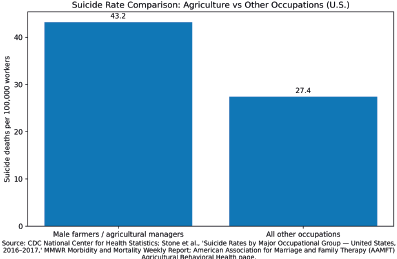
According to data from the National Rural Health
Association (NRHA), male farmers have significantly
higher rates of suicide at 43.2 per 100k compared to
27.4 per 100k for other professions(Eisenreich). This
data, although disconcerting, is not surprising as
farmers’ ability to sustain their livelihoods rests on many
factors, most of which are out of their control, the
biggest factor being the milk price market.
GLD requires a price of $18-20 per hundred lbs of raw
milk in order to break even on operating costs, though
recently prices haven’t been as favorable as they are
sitting closer to the rate of $14 per hundred lbs(Federal
order 30). Swings in pricing this large can lead to
dramatic effects: “Our income [can] fluctuate up to 800k
a year” said Jim.
The International Milk Market
In addition to input and output pressures discussed
earlier, international pressures have made American
domestic farming less vital to the global supply chain.
Jim Leick understands this reality first hand. “Canada’s
sending milk down into the US and oversupply[ing].
Exports would fix things. Countries are expanding their
dairy on their own front,. For instance Saudi Arabia has
government-owned farms.” If Wisconsin dairy farmers
held a larger share of the international market, this
would alleviate a part of their financial burden. With the
recent industry expansions in other countries like Saudi
Arabia, this seems highly unlikely(Dairy Kingdom).
Trump’s tariffs have further exacerbated the situation for
Wisconsin milk exports. During a panel discussion at
UW Madison’s Union South building on March 2nd of
2026, Associate Professor of Finance Scott Baker
explained why the imposition of tariffs can lead to
retaliatory trade barriers. “The norm that underscores
that is reciprocity… the reason you don’t go all out on
protectionist trade is that everyone else will then do it
right back to you. They’ll hold you hostage.” The norm
of reciprocity explains why Jim would be concerned
about China. Jim remarked that “tariffs are turning the
farms upside down. Countries are bucking and China is
not buying commodities.
The government came out with subsidy money, though it’s
not much of anything.” These are the thoughts that keep
Jim Leick awake at night, wondering when prices may
rebound in a positive direction.
Consolidation of firms that control input and output prices
and international pressures on the market contribute to the
likelihood that Jim Leick will be the last family owner of
GLD. Two structural factors led to the economic climate
that threatens farms like GLD: lax anti-trust laws
beginning in the 1970’s, and environmental regulations
placing an R&D burden on farm machinery firms. Larger
firms had the cushion to absorb losses, smaller firms did
not, falling victim to mergers & acquisitions. Recessions
then created an “up or out” subculture, and quickly blew
the sand away from the deregulated reality of American
agriculture. Some farms evolved quickly during a small
window of time where farms could successfully scale up
and continue to modernize before the volatility of the
business cycle became an occupational hazard. This
volatility is what Jim faces today, Yet Jim is not interested
in entertaining the possibility of giving up: “I’ve never
questioned it.” Tina explains that it’s truly a cost-benefit
discussion: “Is this when we pull the pin or is this when we
keep going, especially when it gets good, there’s a moment
where we ask if we should do something else, and every
time the answer is no.”
The environment of the farm, while difficult, carries with it
the legacy of 126 years of Leick family farming and
tradition: “It’s a decent place to raise a family.” Living in
the middle of one’s vocation carries the benefit that family
members are consistently in close proximity. “When we’re
home, we can spend time with [Jim]: he’s not inaccessible.”
The heart and soul of the operation is family. They know
each other like family, and it is only because they know
their relative strengths so well that they can operate
efficiently and keep the business in the black decade after
decade. Tina describes Jim as fitting into an active role
requiring dexterity and attention to lots of moving parts
“He’s always moving and thinking and doing.” Jim agreed.
“I don’t wanna be sitting around the house, I want to go
outside and do something.” This is the same mindset that
rebuilt the walkway floor in a single night, and the mindset
that gets him up in the morning even when he’s sick and
sore and down on his luck. In the words of Elizabeth Leick,
“You don’t stop until the weather makes you stop.”
Alexander, Jeff. 2024. “SMALL TOWNS: Wiese Brothers Farms in
Greenleaf.” Https://Www.wbay.com . WBAY. June 6, 2024.
https://www.wbay.com/2024/06/06/small-towns-wiese-brothers-farmsgreenleaf/
.
Association of Equipment Manufacturers. 2025. “AEM Backs
Wisconsin Legislation to Launch Dairy Innovation Fund, Bolster
Family Farms.” AEM Backs Wisconsin Legislation to Launch Dairy
Innovation Fund, Bolster Family Farms . Association of Equipment
Manufacturers. June 3, 2025. https://newsroom.aem.org/aem-backswisconsin-
legislation-to-launch-dairy-innovation-fund-bolsterfamily-
farms/ .
Bamberg, Jennifer. 2024. “As Ag Consolidation Grows, Harris and
Trump Pitch Different Approaches.” Investigate Midwest. October
29, 2024. https://investigatemidwest.org/2024/10/29/as-agconsolidation-
grows-harris-and-trump-pitch-different-approaches/.
Bromberg, Michael. 2024. “Herfindahl-Hirschman Index – HHI
Definition.” Investopedia. June 12, 2024.
https://www.investopedia.com/terms/h/hhi.asp.
“Dairy Kingdom: Saudi Arabia Makes the Desert Moo.” 2010.
Www.csis.org. April 15, 2010. https://www.csis.org/analysis/dairykingdom-
saudi-arabia-makes-desert-moo.
Deller, Steven, Jeffrey Hadachek, and Leonard Polzin. 2022. “The
Contribution of Dairy to the Wisconsin Economy.”
https://aae.wisc.edu/wp-content/uploads/2024/11/The-Contributionof-
Dairy-to-the-Wisconsin-Economy.pdf.
Eisenreich, Rosalie, and Carolyn Pollari. n.d. “Addressing Higher
Risk of Suicide among Farmers in Rural America.”
https://www.ruralhealth.us/getmedia/98f1009e-5418-4c06-910ccdbb965cdb2e/
NRHA-P olicy-Brief-Increases-in-Suicide-Rates-
Among-Farmers-in-Rural-America.pdf.
Federal Milk Marketing Order 30. History of Class III Milk Prices, 1990–Current.
https://www.fmma30.com/ClassPrice/HistoryofClassIII–1990-
Current.pdf
Fuglie, Keith, Paul Heisey, John L. King, Kelly Day-Rubenstein,
David Schimmelpfennig, Sun Ling Wang, Carl E. Pray, and Rupa
Karmarkar-Deshmukh. 2011. “Research Investments and Market
Structure in the Food Processing, Agricultural Input, and Biofuel
Industries Worldwide.” SSRN Electronic Journal.
https://doi.org/10.2139/ssrn.2027051.
McCracken, John. 2026. “Welcome to Zscaler Directory
Authentication.” Investigatemidwest.org. 2026.
https://investigatemidwest.org/2026/01/21/a-wisconsin-bill-wants-togive-
money-to-small-dairy-farms-industry-groups-say-otherwise
Musharbash, Basel. 2024. “‘Kings over the Necessaries of Life’:
Monopolization and the Elimination of Competition in America’s
Agriculture System.” https://farmaction.us/wpcontent/
uploads/2024/09/Kings-Over-the-Necessaries-of-Life-
Monopolization-and-the-Elimination-of-Competition-in-Americas-
Agriculture-System_Farm-Action.pdf.
Smart, Stacey. 2025. “Ready for the next Generation Expansion,
Remodel Take Gerrits Family into Future.” Dairy Star. May 10,
- https://dairystar.com/stories/ready-for-the-nextgeneration,
28227#:~:text=Expansion%2C%20remodel%20take%20
Gerrits%20family,Stacey%20Smart/Dairy%20Star.