How to Think About Net Exports
By Chloe Song | ShoQs 2026
Tariffs under the current administration are usually discussed in terms of the trade deficit and GDP. Both are tied to a simple macroeconomic idea: net exports.
What are net exports?
Economics defines net exports as the value of a country’s exports minus the value of its imports over a given period. Simply, net exports measure whether a country sells more goods and services to the rest of the world than it buys from other countries.
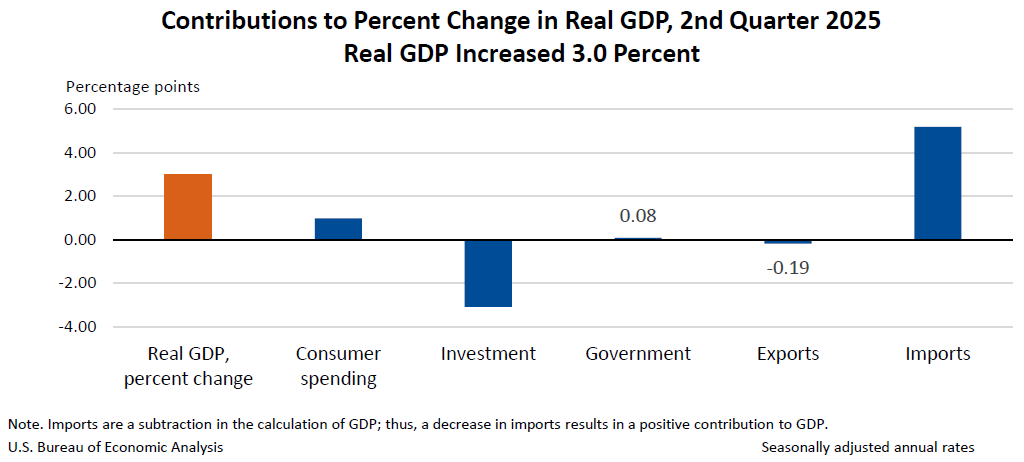
Net exports are one of the components used to calculate GDP. Their role is to ensure that GDP measures the values of goods and services produced domestically, rather than spending alone. Because spending by households, firms, and the government can include imported goods, these purchases are initially counted as part of economic expenditure even though the goods themselves are produced abroad. To prevent foreign production from being included in a measure of domestic output, the value of imports is subtracted, while exports are added.
For example, if you spend $30,000 on an imported car, the $30,000 is counted in consumption yet subtracted as an import, so the net effect on GDP is zero, because no production happened inside the country.
Historical US picture: mostly negative net exports
Historically, the United States has tended to run a trade deficit. According to the St. Louis Fed, US net exports of goods and services have been below zero for most years since the 1970s. At the same time, BEA data shows that US real GDP has grown significantly over that period. That means a country can have persistent trade deficits and still see its overall GDP rise, as long as consumption, investment, government spending, and productivity expand enough to offset the drag from negative net exports.
In the late 1990s, the US trade deficit surged from 1.4% to 3.7% of GDP amid a “new economy” boom, as savings plummeted from 8.7% to 2.4% of GDP while real investment spending soared above 18% of GDP. Strong consumption and technological advances propelled GDP growth despite gaping trade imbalances.
Are positive net exports always good for GDP?
From the equation, a positive net exports number raises GDP. When net exports rise because exports are growing, that usually signals competitive industries and stronger production at home, which tends to support employment and incomes. But if net exports rise mainly from a collapse in imports in which households and firms are cutting back on foreign purchases as they slash overall spending, then the boost from net exports is really happening against a backdrop of weaker consumption and investment.
In the long run, growth depends more on productivity and investment rather than on whether net exports hover above or below zero. However, the composition of trade does still matter, as exporting high value goods and services can support innovation and economies of scale, while persistent reliance on imported capital goods may pose vulnerabilities.

Sources
BEA. “Gross Domestic Product, 2nd Quarter 2025 (Third Estimate), GDP by Industry, Corporate Profits (Revised), and Annual Update | U.S. Bureau of Economic Analysis (BEA).” Bea.gov, 2025, www.bea.gov/news/2025/gross-domestic-product-2nd-quarter-2025-third-estimate-gdp-industry-corporate-profits.
FRED. “Net Exports of Goods and Services.” Stlouisfed.org, 2019, fred.stlouisfed.org/series/NETEXP.
Pakko, Michael R. “The U.S. Trade Deficit: Sideshow to the “New Economy”?” Stlouisfed.org, Federal Reserve Bank of St. Louis, Apr. 2000, www.stlouisfed.org/publications/regional-economist/april-2000/the-us-trade-deficit-sideshow-to-the-new-economy.